
Taking your Business Online can help you reach more customers and grow your brand faster.
“Learn the ultimate 5-pillar strategy to grow your local business online in 2026. Master GBP, local SEO, reviews, ads & analytics. Start attracting customers today!”
“In 2026, taking your business online can help you reach more customers…”
Introduction: The Digital-First Local Consumer
Did you know that 82% of consumers read online reviews for local businesses before making a purchase decision? Furthermore, 76% of people who search for something “near me” on their smartphone visit a related business within a day. These aren’t just statistics; they are the loud, clear signal of a paradigm shift in consumer behavior. The “Yellow Pages” era is a distant memory. Today, the local business landscape is defined by digital discovery.
For the local business owner—whether you run a cozy café in Austin, a plumbing service in London, or a dental clinic in Sydney—the rules of engagement have changed forever. The problem is not a lack of options; it’s the overwhelming abundance of them. You are bombarded with advice: “Start a TikTok!”, “Run a Facebook Ad!”, “Get on Google My Business!” While each piece of advice has merit, a scattergun approach without a cohesive strategy is a recipe for wasted budget, burnout, and frustration.
You are not just competing with the business across the street anymore; you are competing with every business in your city that has a superior online presence. The truth is, if a potential customer cannot find you, they will find your competitor. Conversely, if they find you but are met with a slow website, outdated information, or a cascade of negative reviews, you have lost the sale before you even had the chance to pitch.
So, how do you navigate this digital maze and build a robust online presence that actually grows your local business? The answer lies in a holistic, proven, multi-pillar strategy.
As someone who has spent the last two decades navigating the choppy waters of digital marketing, I have seen trends come and go. However, the fundamentals of local business growth remain consistent. It is about building a digital ecosystem that is discoverable, trustworthy, engaging, and measurable.
In this masterclass, I will break down the ultimate strategy to grow your local business online into five distinct, actionable pillars:
- Laying the Foundation: Your website and Google Business Profile.
- The Engine of Trust: Managing your online reputation.
- Paving the Digital Path: Mastering Local SEO and content.
- Fueling Growth: Strategic local advertising.
- Maintaining Momentum: Tracking and data-driven optimization.
This is not just about theory. This is a practical playbook designed to transform your online presence from a digital placeholder into your most powerful sales asset. Let’s get started.
Social media is one of the easiest ways to promote your business online.
2. Pillar 1: Laying the Foundation – Your Digital Storefront
A strong Business Online strategy allows you to attract potential customers through search engines and social media.
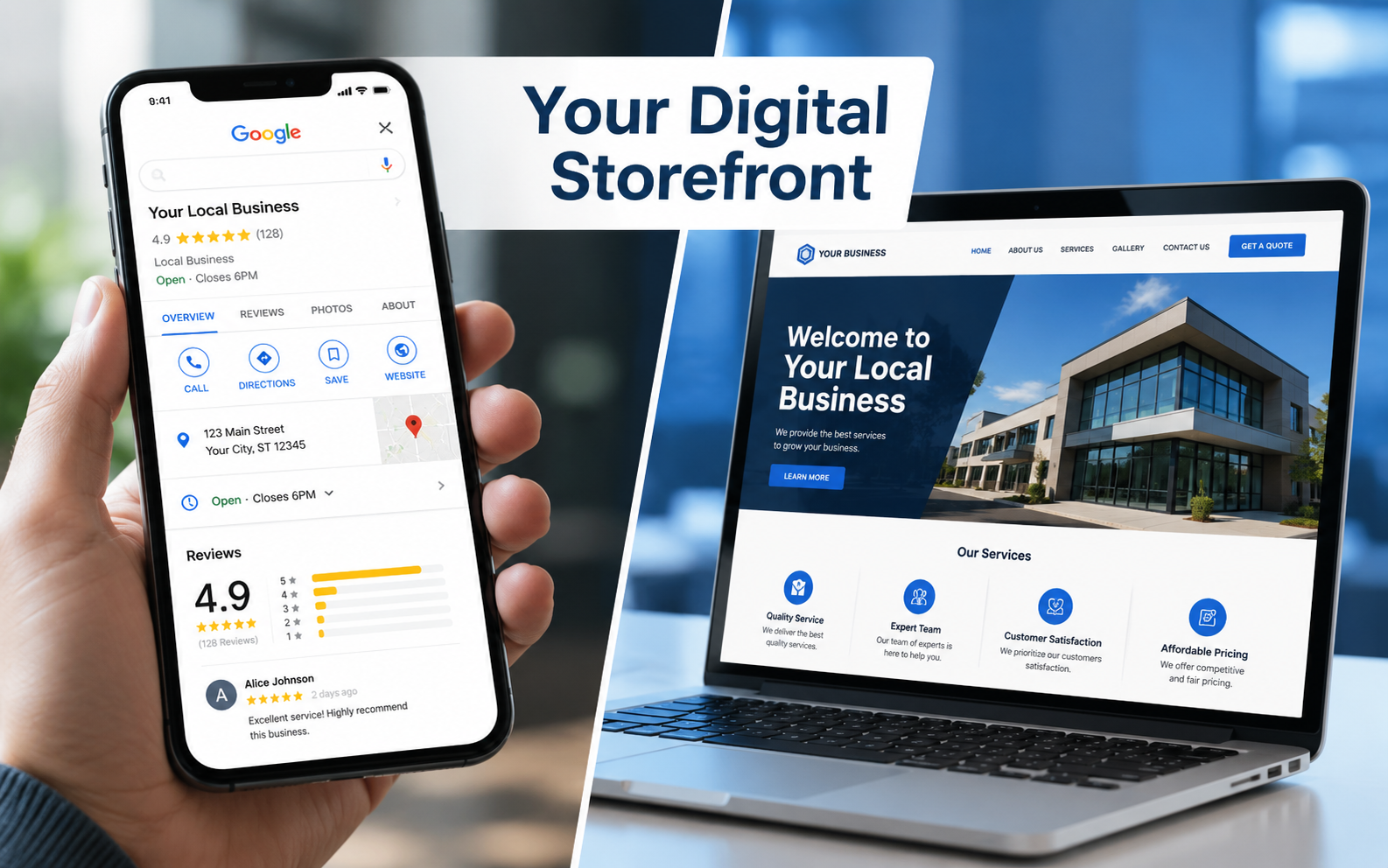
Imagine opening a physical store in the most popular shopping district in your city. You have a great location, high foot traffic, and an attractive window display. But what if the door was jammed? What if the lights were dim and flickering, and the sign outside had a typo in your phone number? This is precisely the mistake many local businesses make online.
Your digital storefront has two key components: your website and your Google Business Profile. These are the front doors to your business. If they are not pristine, professional, and optimized, you are turning away customers before they even walk in.https://business.instagram.com/?utm_source=chatgpt.com
2.1. The Cornerstone: Your Website & User Experience (UX)
Your website is the central hub of your digital presence. It is where you control the narrative, build your brand, and ultimately convert visitors into leads and customers. In a world where attention spans are shrinking, every second counts.
The Non-Negotiable of Mobile-First Indexing
Did you know that over 60% of all Google searches now come from mobile devices? Google has officially shifted to mobile-first indexing. This means that the search engine predominantly uses the mobile version of your content for indexing and ranking. If your website is not perfectly optimized for smartphones and tablets, you are effectively invisible to a majority of your potential customers.
Actionable Steps:
- Responsive Design: Ensure your website uses a responsive design that automatically adjusts to any screen size.
- Speed is Currency: Use tools like Google PageSpeed Insights to test your site. Compress images, enable browser caching, and leverage a Content Delivery Network (CDN) to make your site load in under 3 seconds. A one-second delay in page load can reduce conversions by 7%.
- Clear Call-to-Actions (CTAs): On mobile, thumb tapping is key. Ensure your buttons are large, easily clickable, and clearly state the action you want the user to take: “Call Now,” “Book an Appointment,” “Get a Free Quote.”
Local Content Integration
Your website shouldn’t just be a generic brochure. It must scream “local.” Embed a Google Map on your ‘Contact Us’ page. Create dedicated landing pages for the specific neighborhoods or cities you serve. Mention local landmarks, events, or community news in your blog posts. This signals to Google that you are a relevant entity in that specific geographical area.
2.2. The Local King: Google Business Profile (GBP) Optimization
If your website is your headquarters, your Google Business Profile is your high-traffic billboard. It is arguably the single most important factor in your local search strategy. This is the snippet that appears on Google Maps and in the “Local Pack” (the top three results shown for local searches). It provides essential information at a glance: your address, phone number, reviews, hours of operation, and photos.
A complete and optimized GBP is not a suggestion; it is a requirement for ranking. Google rewards businesses that provide a complete picture.
Step-by-Step GBP Optimization Checklist:
- Claim and Verify: This is step zero. If you haven’t claimed your listing, go to Google Business Profile and do it immediately. Google will send a postcard with a verification code to your physical address.
- NAP Consistency is King: Your Name, Address, and Phone Number must be absolutely identical across your website, Google, and all other online directories. Even a minor discrepancy (like “St.” vs. “Street”) can confuse search engines and hurt your rankings.
- Category Mastery: This is one of the most critical factors. Select the most specific primary category for your business (e.g., “Italian Restaurant” rather than just “Restaurant”). Then, add as many relevant secondary categories as possible (e.g., “Pizza Takeout,” “Caterer,” “Event Venue”).
- Compelling Business Description: Write a rich, keyword-dense description of your business. Use your primary keyword, grow local business online, naturally, but ensure it is engaging and human-friendly. Tell your story and highlight what makes you unique.
- Visual Storytelling: Businesses with photos receive 42% more requests for directions and 35% more click-throughs to their websites. Upload high-quality, professional photos of your storefront, your team, your products, and your customers (with permission). Add videos to showcase your services in action.
- Google Posts: Treat Google Posts like a mini-social media feed. Use them to share daily specials, announce upcoming events, highlight new products, and promote special offers. This shows Google (and your customers) that your business is active and engaged.
3. Pillar 2: The Engine of Trust – Online Reputation Management
The internet has democratized opinion.Business Online Today, your reputation isn’t built on billboards or word-of-mouth alone; it is forged in the digital crucible of online reviews. Your customers trust strangers on the internet as much as they trust personal recommendations, and Google takes notice.
Managing your online reputation is not about burying negative feedback; it is about building a transparent, trustworthy, and customer-centric digital persona.https://analytics.google.com/?utm_source=chatgpt.com
3.1. The Power of Social Proof: Reviews and Ratings
A recent study found that the average consumer reads about 10 online reviews before feeling they can trust a local business. Those reviews are social proof, acting as powerful endorsements that sway purchasing decisions.
Key Statistics:
- 91% of people are more likely to use a business with positive reviews.
- Having an average star rating of 4.0 or higher is crucial to be considered in the local pack.
3.2. A Proactive Strategy for Getting More Reviews
Waiting for reviews to happen organically is a slow and unreliable strategy. You need a system.
- Ask at the Right Moment: The best time to ask for a review is immediately after a successful interaction. A customer who just received a fantastic service or enjoyed a delicious meal is highly motivated to share their positive experience.
- Make it Easy: Don’t just ask; provide a direct link. Use a review management tool or simply generate a short link to your Google Business Profile review form. Add this link to your email signature, your website, and post-purchase follow-up emails.
- In-Person Request: Train your staff to ask for reviews in person. A simple, “We’re so glad you enjoyed your meal! If you have a moment, we would really appreciate if you could leave us a review on Google” can be incredibly effective.
3.3. The Art of Responding to Reviews (Both Good and Bad)
Engagement is key. Responding to all reviews shows you are an active and caring business owner.
- Responding to Positive Reviews:
- Do not just say “Thanks.” Be personal. If they mention a specific employee or dish, acknowledge it. Example: “Thank you, Sarah! We are so thrilled you enjoyed the new summer special. We’ll let our team know you appreciated their hard work!”
- Responding to Negative Reviews:
- This is where you can truly shine and build trust. Never get defensive.
- Acknowledge and Apologize: Start by thanking them for their feedback. “We are so sorry to hear about your experience, John. This is not the standard we aim for.”
- Take it Offline: Offer to resolve the issue privately. “We would love the opportunity to make things right. Could you please send us an email at [your email address] so we can discuss this further?”
- Show Empathy: Other potential customers are watching. A professional, empathetic response to a negative review often builds more trust than a glowing five-star review itself.
4. Pillar 3: Paving the Digital Path – Local SEO & Content Strategy
Now that your storefront is shiny and your reputation is stellar, you need to drive traffic. This is the domain of Local SEO.
Local SEO is the practice of optimizing your online presence to attract more business from relevant local searches. This is about ensuring that when someone in your city searches for your services, you are at the top of the list.
4.1. Dominating Local Search Beyond Google Maps
Local SEO Business Onlinegoes beyond just optimizing your GBP. It extends to your website, your content, and your citations (listings on other websites).
4.2. On-Page SEO for Local Businesses
- Title Tags and Meta Descriptions: Every page on your website should have a unique and compelling title tag and meta description. These are the first things users see on the search results page. Ensure they include your primary keyword and your location. Example Title Tag: “Best Plumber in Austin | Expert Plumbing Services | [Your Company Name].”
- Location Pages: If you serve multiple cities or neighborhoods, create a specific, dedicated page for each one. Each page should have unique, high-quality content that speaks directly to that community. Mention local streets, landmarks, and community events. This is a massive, often overlooked opportunity to grow your local business online.
- Schema Markup: Implement LocalBusiness schema on your website. This is a piece of code that helps search engines understand your business better and can result in rich snippets, like star ratings and hours, showing up in search results.
4.3. The “Near Me” Strategy: Content that Answers Local Queries
People don’t just search for “best plumber”; they search for “best plumber near me” or “emergency plumber in [City].” You must create content that answers these specific queries.
- Create Hyper-Local Content: Write blog posts about local events, sponsor a local sports team and write about it, or create a “Ultimate Guide to Home Renovation in [City Name].”
- Frequently Asked Questions (FAQ) Page: Create an FAQ page that answers common questions your customers have. This is a fantastic way to target long-tail keywords with lower competition.
- Case Studies: Showcase your work in specific local neighborhoods. “How We Helped a Family in [Neighborhood] with Their Roofing Emergency.” This demonstrates your expertise and reinforces your local presence.Business Online
5. Pillar 4: Fueling Growth – Targeted Local Advertising
While organic traffic from SEO is the long-term goal, it takes time to build. To generate immediate results and fuel rapid growth, you need a strategic paid advertising plan.
5.1. Paid Strategy: Getting Fast, Targeted Results
Paid ads are the nitro boost for your local business. They allow you to put your business in front of high-intent customers right now.
5.2. Leveraging Google Ads for High-Intent Local Traffic
- Google Local Services Ads (LSA): If you are a service-based business (plumber, electrician, lawyer, real estate agent), this is an absolute game-changer. You only pay for qualified leads, not clicks. It puts you at the very top of the search results with a “Google Guaranteed” badge, which is a huge trust signal.
- Google Search Ads: Create campaigns targeting high-intent keywords like “emergency plumber near me.” Use location extensions so your address and phone number are displayed prominently. Bid on your competitor’s names to capture their audience.
5.3. The Visual Appeal: Social Media Advertising
Organic reach on social media is declining, but the targeting capabilities are breathtaking.
- Hyper-Targeting on Facebook and Instagram: You can target people within a specific radius of your business (e.g., 5 miles). You can target people based on their interests (e.g., “home renovation” for a home depot) or even demographics. This allows you to get your message in front of the exact people who are likely to become customers.
- Show Your Personality: Social media ads are for building a community and showcasing your brand. Use high-quality images or videos, highlight customer testimonials, and show the people behind the business. Don’t just sell; connect.Business Online
5.4. The Power of Retargeting
Ever looked at a product online and then seen an ad for it everywhere? That is retargeting. A vast majority (over 95%) of your website visitors will leave without converting. Retargeting allows you to show ads specifically to these people as they browse other websites or social media. It is a highly effective way to stay top-of-mind and bring potential customers back to complete a transaction.
6. Pillar 5: Maintaining Momentum – Tracking & Analytics
You cannot manage what you do not measure. The final pillar of this strategy is to build a system for tracking your progress. This allows you to double down on what works and ditch what doesn’t.
6.1. Measuring What Matters: Setting Up Your Dashboard
Forget “likes” and “followers.” They are vanity metrics. Focus on conversion metrics that actually drive revenue.
6.2. Key Performance Indicators (KPIs) for Local Business
- Google Business Profile Insights:
- Driving Directions Clicks: How many people are looking up your location to come visit?
- Phone Calls: This is a direct lead. Measure this religiously.
- Website Clicks: People moving from your GBP to your website.
- Website Analytics:
- Form Submissions: Contact forms filled out.
- Click-to-Call: People clicking on your phone number on your website.Business Online
6.3. Using Google Analytics & Google Search Console
- Google Analytics will show you which channels are driving traffic (organic, paid, social) and what users are doing on your site. You can see which pages are converting best and which have high bounce rates.
- Google Search Console reveals the exact queries people are searching for to find your business. This is invaluable for refining your content and keyword strategy. You can see which keywords are driving impressions and clicks.
6.4. The Importance of Monthly Audits
Dedicate time each month for a health check.
- NAP Consistency Audit: Check your business name, address, and phone number across all your listings (Yelp, Facebook, etc.). Correct any inconsistencies.
- GBP Audit: Check for any new features Google has released. Ensure your hours are correct for holidays. Update your Google Posts.Business Online
- Review Audit: Check for new reviews and respond to them promptly.
- Website Speed Audit: Run a speed test to ensure your site is still loading quickly.
7. Conclusion: The Digital Transformation is a Marathon, Not a Sprint
Growing your local business online is not a one-time project; it is an ongoing commitment. It requires patience, consistency, and a willingness to adapt.
It can be tempting to look for a silver bullet, a single tactic that will solve everything. But the reality is, the businesses that thrive in the digital age are the ones that build a comprehensive strategy. They have a stunning website that converts, a flawlessly optimized Google Business Profile, a stellar online reputation, a steady flow of high-quality local content, a smart ad strategy, and the data to track it all.
Do not let the length of this guide intimidate you. You do not have to implement everything at once.
Your first step today: Pick one pillar. Start with Pillar 1. Audit your Google Business Profile. Fix your NAP consistency. Write a compelling business description. Pick one action and start immediately.
The digital transformation of your business is a marathon, not a sprint. The journey of a thousand miles begins with a single step. Start that step today and begin implementing this strategy to grow your local business online.
Your future customers are searching for you right now. Are you ready to be found?