
What is Digital Marketing? A complete beginner’s guide covering SEO, Social Media, PPC, Email & more. Start your online marketing journey today.ptember 2026 | Reading Time: 18 minutes
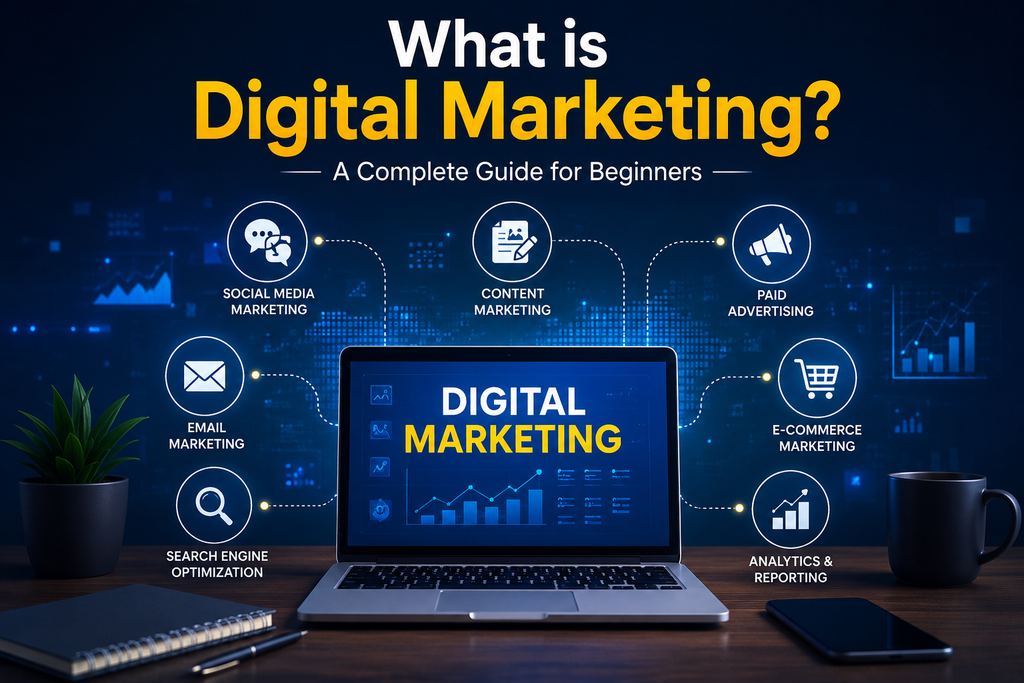
Introduction: The Digital Shift Nobody Can Ignore
Imagine waking up one morning to find that your business has vanished from the map. No foot traffic. No phone calls. No new customers. Terrifying, right?
Now imagine that same scenario, but instead of a physical location, your business has vanished from Google. No one can find your website. Your social media pages are silent. Your email inbox is empty. For millions of businesses in 2026, this is a daily reality—not because they don’t have a good product, but because they don’t have a digital marketing strategy.
So, what is digital marketing?
At its core, digital marketing is the act of promoting products, services, or brands using electronic devices and the internet. But that sterile definition doesn’t do it justice. Think of it this way: Traditional marketing is like shouting in a crowded stadium—loud, expensive, and you have no idea if anyone is listening. Digital marketing is like having a one-on-one conversation with every single person in that stadium, at the exact moment they’re ready to buy, and tracking every word they say.
If you’re a small business owner, a student, a career changer, or a traditional business owner who grew up with billboards and Yellow Pages, this guide is for you. The digital world can feel overwhelming—algorithms change, platforms rise and fall, and jargon flies around like confetti. But here’s the secret the experts don’t tell you: The fundamentals never change. Master the fundamentals, and you’ll survive any algorithm update.
In this complete guide for beginners, we’ll walk you through:
- Why digital marketing matters more than ever (and how it levels the playing field)
- The 7 pillars of digital marketing (your toolbox for success)
- The psychology behind the marketing funnel
- A step-by-step action plan to get started today
- Common mistakes to avoid (so you don’t waste your budget)
- What the future holds for online marketing
Ready? Let’s dive in. By the end of this digital marketing guide, you’ll have a clear roadmap to grow your business online—even if you’re starting from absolute zero.
Chapter 1: Why Digital Marketing? (The “Why” Behind the “What”)
Before we jump into the how, we need to understand the why. Why should a business owner—who has survived decades without a website—suddenly care about online marketing? The answer lies in three words: Reach, Relevance, and Results.
1. Leveling the Playing Field
Here’s a story. Meet Sarah, a home baker in Austin, Texas. She makes the best sourdough bread in her neighborhood. Across town, there’s a multinational bakery chain with a million-dollar marketing budget. In the old world, Sarah could never compete. She couldn’t afford a TV commercial or a billboard on the highway.
But in the digital world? Sarah started a local SEO campaign. She optimized her Google Business Profile, collected 50 five-star reviews, and wrote blog posts about “Best Sourdough in Austin.” Within six months, when locals searched for “bakery near me,” Sarah’s small shop appeared above the multinational chain. Why? Because Google prioritizes relevance and locality over brand size.
That’s the beauty of digital marketing for beginners: it doesn’t matter how big your wallet is. It matters how smart your strategy is.
2. Measurability (No More Guessing)
Traditional marketing is a black box. You spend $5,000 on a newspaper ad, and you wait. Did it work? Did anyone see it? Did it drive sales? You’re basically guessing.
Digital marketing is the opposite. Every click, every view, every second spent on your website can be tracked. Tools like Google Analytics 4 (GA4) and Google Search Console give you a dashboard of truth. You can see exactly how many people visited your site, where they came from, what they did, and—most importantly—how many converted into paying customers. This level of transparency means you never waste money on what doesn’t work. You double down on what does.
3. Hyper-Targeting
Imagine you’re a luxury watch seller. You don’t want to show ads to teenagers who can’t afford your product. With digital advertising, you can target only men and women aged 35–55, with household incomes above $150,000, who have recently searched for “luxury watches” or visited watch forums. You can even retarget people who visited your site but didn’t buy.
This is called audience segmentation, and it’s the secret weapon of modern online advertising. You’re not wasting money on people who will never buy. You’re investing only in your ideal customers.
4. Cost-Efficiency
Let’s talk numbers. A 30-second Super Bowl ad costs around $7 million—for one slot. That’s money that only the biggest brands can afford. By contrast, a well-optimized Pay-Per-Click (PPC) campaign on Google or Facebook can start with just $100. You can test, iterate, and scale your campaigns with a fraction of the cost, often generating an ROI (Return on Investment) that’s 2x, 5x, or even 10x your spend.
Statistic: According to HubSpot, businesses that blog see 67% more leads than those that don’t. And companies that prioritize SEO are 13 times more likely to see a positive ROI.
In short: Digital marketing isn’t just “nice to have.” It’s the most effective, efficient, and equitable way to grow a business in the 21st century. Now, let’s look under the hood and explore the digital marketing channels that make it all possible.https://analytics.google.com/?utm_source=chatgpt.com
Chapter 2: The 7 Pillars of Digital Marketing (Your Complete Toolkit)
Think of digital marketing like a mechanic’s toolbox. You don’t need every single tool for every single job. But you need to know what each tool does so you can pick the right one at the right time. Here are the 7 pillars that form the foundation of any successful online marketing strategy.
Pillar 1: Search Engine Optimization (SEO)
SEO is the art and science of getting your website to rank higher on search engines like Google, Bing, and Yahoo. When someone searches for “best coffee maker” or “plumber near me,” you want your website to appear on the first page—ideally, in the top three results.
SEO is broken down into three main components:
- On-Page SEO: This involves optimizing your content, titles, meta descriptions, and headers. It’s about telling Google, “Hey, my page is the best answer to this question.”
- Off-Page SEO: This focuses on building backlinks—other websites linking to your content. Think of backlinks as “votes of confidence.” The more high-quality votes you have, the more Google trusts you.
- Technical SEO: This deals with the backend of your website—site speed, mobile-friendliness, sitemaps, and structured data. If your site is slow or broken, Google will penalize you, no matter how good your content is.
Google uses a framework called E-E-A-T (Experience, Expertise, Authoritativeness, and Trustworthiness) to evaluate content. If your content demonstrates real experience and expertise, you’ll rank higher.
Pillar 2: Pay-Per-Click (PPC) / Search Engine Marketing (SEM)
While SEO is “free” (you don’t pay for clicks), it takes time. PPC is the shortcut. With PPC, you bid on keywords, and when someone searches for that keyword, your ad appears at the very top of the search results. You only pay when someone actually clicks on your ad—hence, Pay-Per-Click.
Google Ads is the most popular PPC platform. It operates on an auction system. Your ad rank depends on your bid amount and your Quality Score (a measure of how relevant and useful your ad is). A high Quality Score means you pay less per click and get better ad positions.
PPC also includes retargeting—showing ads to people who have already visited your website but didn’t convert. It’s a gentle reminder that says, “Hey, you were looking at this product. Still interested?”
Pillar 3: Social Media Marketing (SMM)
Social media is where people hang out. As a marketer, you need to be where your audience is. Social Media Marketing involves two distinct approaches:
- Organic Social Media: Posting content on platforms like Facebook, Instagram, LinkedIn, Twitter, and TikTok to build a community and engage with followers. This is free but requires consistent effort.
- Paid Social Media: Running ads on these platforms to reach a wider audience. The targeting capabilities are mind-blowing—you can target by age, location, interests, job title, behavior, and even life events.
The key to social media success is simple: Fish where the fish are. If you’re a B2B software company, LinkedIn is your goldmine. If you’re a fashion brand, Instagram and TikTok are your playgrounds. Don’t spread yourself thin across every platform. Choose one or two and do them exceptionally well.
Pillar 4: Content Marketing
Content marketing is the fuel for all other digital marketing channels. It’s the practice of creating valuable, relevant, and consistent content to attract and retain a clearly defined audience.
Content isn’t just blog posts (though they’re a big part of it). It includes:
- E-books and whitepapers
- Webinars and video tutorials
- Podcasts
- Infographics
- Case studies
The philosophy behind content marketing is simple: Give value first, and the sales will follow. When you provide free, high-quality information, you build trust with your audience. They see you as an expert. When they’re ready to buy, they’ll come to you.
A popular technique in content marketing is the Skyscraper Technique, created by Brian Dean. You find a piece of content that’s already performing well, create something even better (more detailed, more visual, more up-to-date), and then reach out to people who linked to the original piece and ask them to link to yours instead.
Pillar 5: Email Marketing
Let’s debunk the biggest myth in marketing right now: Email is not dead. In fact, email marketing has an average ROI of $36 for every $1 spent. That’s a 3,600% return.
Email is considered owned media. Unlike social media (where you’re renting space on someone else’s platform), your email list is yours. No algorithm change can take it away from you.
Email marketing isn’t just about blasting promotions. It’s about nurturing relationships. Here are a few common email marketing strategies:
- Welcome Series: Automated emails sent to new subscribers welcoming them and introducing your brand.
- Drip Campaigns: A series of emails sent over time to educate and nurture leads.
- Abandoned Cart Emails: When someone adds a product to their cart but doesn’t check out, you send them a reminder—often with a discount.
- Newsletters: Regular updates with valuable content, company news, and occasional promotions.
Tools like Mailchimp, ConvertKit, and ActiveCampaign make email marketing easy—even for beginners.
Pillar 6: Affiliate Marketing
Affiliate marketing is performance-based marketing. You pay other people (affiliates) to promote your products. They earn a commission for every sale or lead they generate.
Think of it as having a sales force that only gets paid when they perform. It’s a win-win: affiliates have an incentive to sell your product, and you only pay for results. Amazon’s affiliate program (Amazon Associates) is one of the most well-known examples.
Pillar 7: Analytics and Data
Data is the backbone of digital marketing. You can’t improve what you don’t measure.
Google Analytics 4 (GA4) is the industry standard. It helps you track:
- How many people visit your site (Traffic)
- Where they come from (Source/Medium)
- What they do on your site (Behavior)
- How many of them convert (Conversions)
Google Search Console, on the other hand, helps you monitor how your site performs in organic search. It shows you which keywords you rank for, your click-through rates, and any technical issues affecting your visibility.
Data turns marketing from guesswork into science.
Chapter 3: The Digital Marketing Funnel (How Strategy Works)
Now that you understand the individual channels, let’s discuss how they work together. The marketing funnel—also known as the AIDA model—visualizes the customer journey from stranger to customer.
Awareness (Top of Funnel)
At this stage, people don’t know your brand exists. Your goal is to get on their radar. SEO, Social Media posts, and Display Ads are all great for Awareness. You’re not selling yet; you’re simply introducing yourself.
Interest (Middle of Funnel)
Now the person knows you exist. They’re interested, but they’re not ready to buy. They want to learn more. This is where Content Marketing (blog posts, videos, webinars) shines. You provide educational material that helps them solve a problem. In doing so, you position yourself as a trusted authority.
Desire (Bottom of Funnel)
The person has moved from “I’m interested” to “I want this.” They’re comparing options. This is where Email Marketing and Retargeting Ads come into play. You send personalized offers, customer testimonials, and case studies to nudge them toward choosing you over your competitors.
Action (Conversion)
This is the final step. The person makes a purchase, signs up for a service, or downloads your app. Your landing page, checkout process, and Call-to-Action (CTA) must be optimized to remove any friction and make the process as easy as possible.
The old way of marketing was just about selling. The new way is about helping. If you help people at every stage of their journey, they will reward you with their trust—and their business.
Chapter 4: Getting Started (Your First Step Action Plan)
If you’re feeling overwhelmed, take a deep breath. Digital marketing is a marathon, not a sprint. You don’t need to implement all 7 pillars at once. In fact, trying to do everything will likely result in doing nothing well.
Here’s a simple, 5-step action plan for beginners:
Step 1: Set SMART Goals
Before you do anything, define what success looks like. Use the SMART framework:
- Specific: “I want to get 100 new email subscribers.”
- Measurable: “I can track this in Mailchimp.”
- Achievable: “I will post twice a week and run one ad.”
- Relevant: “Email subscribers are likely to convert into customers.”
- Time-bound: “I will achieve this in 30 days.”
Step 2: Identify Your Audience (Create a Buyer Persona)
Who are you trying to reach? Get specific. Create a fictional persona that represents your ideal customer. Give them a name, age, job, income, interests, and pain points.
Example: “Digital Donna” is a 34-year-old mother of two, runs a small boutique, wants to learn social media marketing but doesn’t have a lot of time or budget. She’s active on Instagram and reads mom blogs.
Once you know Donna, you’ll know exactly where and how to reach her.
Step 3: Pick ONE Channel
Based on your persona, pick just one digital marketing channel to focus on initially.
- If you’re B2B, start with LinkedIn and SEO.
- If you’re a local business, start with Google Business Profile and local SEO.
- If you’re a visual brand (fashion, food, decor), start with Instagram.
- If you’re a service provider, start with content marketing (blogging) and email.
Master one channel before expanding to another.
Step 4: Set Up a Landing Page and Email Capture
You need a place to send your traffic. A landing page is a single page designed for one specific goal—like capturing an email address or selling a product. Use tools like Leadpages, Unbounce, or even a simple WordPress page.
Offer a lead magnet—a free resource in exchange for an email address. This could be an e-book, a checklist, a discount code, or a free consultation.
Step 5: Install Google Analytics and Search Console
Set up these free tools from day one. They’ll collect data so that in 30 days, you can analyze what worked and what didn’t. Without data, you’re flying blind.
Chapter 5: The Future of Digital Marketing (What’s Coming Next)
Digital marketing never stands still. Here are three trends that are shaping the future:
1. AI and Automation
AI tools like ChatGPT, DeepSeek, and Midjourney are transforming content creation, data analysis, and customer service. AI can write blog drafts, generate images, analyze customer sentiment, and even run ad campaigns. The key is to use AI as an assistant, not a replacement. Human creativity, empathy, and strategy are still irreplaceable.
2. The Cookieless Future
For years, third-party cookies have allowed advertisers to track users across the web. But with privacy concerns on the rise—and browsers like Safari and Chrome phasing out cookies—marketers need to shift to first-party data. This means building direct relationships with your audience through email, CRM systems, and community engagement.
3. Short-Form Video
TikTok, Instagram Reels, and YouTube Shorts have exploded in popularity. Short-form video is engaging, easily shareable, and favored by algorithms. If you haven’t started creating short videos, now is the time.
4. Voice and Visual Search
More people are using voice assistants (Siri, Alexa) and visual search (Google Lens). Optimizing your content for conversational queries and high-quality images is becoming increasingly important.
Chapter 6: Common Digital Marketing Mistakes to Avoid
Even seasoned marketers make mistakes. Here are the most common pitfalls for beginners—and how to avoid them:
1. Ignoring Mobile Optimization
Over 60% of all internet traffic comes from mobile devices. If your website isn’t mobile-friendly, you’re losing more than half your potential customers. Always test your site on mobile.
2. Not Having a Clear Call-to-Action (CTA)
Every piece of content should have a purpose. “Read more,” “Buy now,” “Subscribe,” “Download”—be explicit about what you want the user to do next. A vague CTA leads to vague results.
3. Chasing Vanity Metrics
Likes, followers, and page views feel good, but they don’t pay the bills. Focus on metrics that actually matter: conversion rate, cost per acquisition, email open rate, and customer lifetime value.
4. Neglecting Email List Building
You don’t own your social media audience. Facebook or Instagram could shut down your account tomorrow. Your email list, however, is your digital real estate. Build it from day one.
5. Not Testing and Iterating
Digital marketing is a game of constant experimentation. What works today might not work tomorrow. Always test different headlines, ad creatives, subject lines, and CTAs. Keep what works and discard what doesn’t.
Conclusion: Your Digital Journey Starts Today
We’ve covered a lot of ground. From the basics of what digital marketing actually is, to the 7 pillars that form the backbone of online marketing, to the customer journey, to actionable steps you can take today.
Here’s the bottom line: The best time to start your digital marketing journey was yesterday. The second best time is right now.
You don’t need a huge budget. You don’t need a fancy degree. You just need a willingness to learn, a clear strategy, and the courage to take the first step.
So, what’s your next move?
- Will you set up your Google Business Profile today?
- Will you write your first blog post this week?
- Will you create that lead magnet and start building your email list?
Whatever you choose, remember: Every expert was once a beginner. The only failure is not starting at all.
Ready to take the first step? Download our free Digital Marketing Starter Checklist below. It’s a simple, actionable PDF that walks you through every step we discussed in this guide. Or, if you have questions, leave a comment below—we’d love to know which channel you’re planning to start with. We’re here to help.
Frequently Asked Questions (FAQs)
1. What is digital marketing in simple words?
Digital marketing is simply using the internet and electronic devices to connect with potential customers and promote your products or services. Instead of using billboards or TV ads, you use tools like Google, social media, email, and websites to reach people right where they spend their time—online.
2. How can I learn digital marketing for free?
There are excellent free resources available. Google offers free certifications through Google Digital Garage and Google Analytics Academy. HubSpot Academy provides comprehensive free courses on SEO, social media, and content marketing. YouTube is also a goldmine of tutorials. Start with these and build your skills step by step.
3. Which digital marketing channel is best for beginners?
For most beginners, SEO (Search Engine Optimization) and Content Marketing (blogging) are excellent starting points because they build long-term, sustainable traffic. If you have a small budget and want quick results, Pay-Per-Click (PPC) advertising on Google or Facebook is also viable. The best channel depends on your business type and audience.
4. Can I do digital marketing myself without hiring an agency?
Absolutely. Many small business owners successfully manage their own digital marketing, especially in the early stages. With the right learning resources, tools, and patience, you can run effective campaigns yourself. Once you start scaling and seeing results, you can consider hiring freelancers or agencies to handle specific tasks.
5. How much does digital marketing cost for a small business?
Digital marketing costs vary widely depending on your goals and strategy. You can start with a budget as low as $100–$500 per month for PPC ads or content creation. As you grow, you can increase your budget. The beauty of digital marketing is that you control your spending and can start small, scaling up as you see positive returns.
6. How quickly can I see results from digital marketing?
SEO and content marketing are long-term strategies; it typically takes 3–6 months to start seeing significant organic traffic. However, PPC (paid ads) can generate immediate results—you can see traffic and leads within hours of launching a campaign. A balanced approach often works best: use paid ads for quick wins while building your organic presence for sustainable growth.
Suggested Internal Links:
- Beginner’s Guide to SEO
- How to Create a Buyer Persona
- Email Marketing Tools for Small Businesses
Suggested External Link:
- Google Digital Garage (Free Certification)